
What the EF? How to Support Planning & Prioritization
A guide for parents, partners, relatives, friends, and professionals supporting ADHDers. Part of the What the EF? Executive Functioning blog series
Companion blog: What the EF? Understanding Planning & Prioritization
Before we begin, if you haven’t already read our companion blog, we recommend doing so first and then returning here.
When someone struggles with planning and prioritization, it's easy to assume they just aren't trying hard enough, don't care, or need to be more organized. But for many people with ADHD, these skills rely on executive functioning processes that simply don't happen automatically.
Planning and prioritization require us to hold multiple pieces of information in mind, estimate time, anticipate future needs, organize tasks into a logical sequence, determine what matters most, and decide where to begin. That's a tremendous amount of mental work happening behind the scenes. Those who seem to “just know” how to do this, may not even realize how many mental processes they have running at one time. But, for those of us who struggle with executive functioning, these invisible steps feel like huge roadblocks, whether we can even fully identify and understand what exactly the barrier is.
The good news is that planning and prioritization can be supported. The goal isn't to do everything for someone else, but rather to reduce unnecessary cognitive load while helping them strengthen their skills in these areas.
Start With Curiosity Instead of Assumptions
When plans fall apart,never even get made, or you see your ADHD loved one working on the thing that is definitely NOT the priority (in your view), it’s natural that your brain will ask, “Why?” Unfortunately, because of the general lack of understanding of executive functioning, we often fill in the blanks with inaccurate assumptions.
Instead of thinking:
"They're just procrastinating."
"They don't care."
"They're waiting for me to do it."
Try asking yourself:
“What part of this process might be difficult right now?”
Often, the struggle isn't motivation. It's decision paralysis. Their ADHD brain may feel overwhelmed by too many choices that all feel equally important to them and they don’t know how to sort that out.
Curiosity can help open the door to collaboration and avoid conflict.
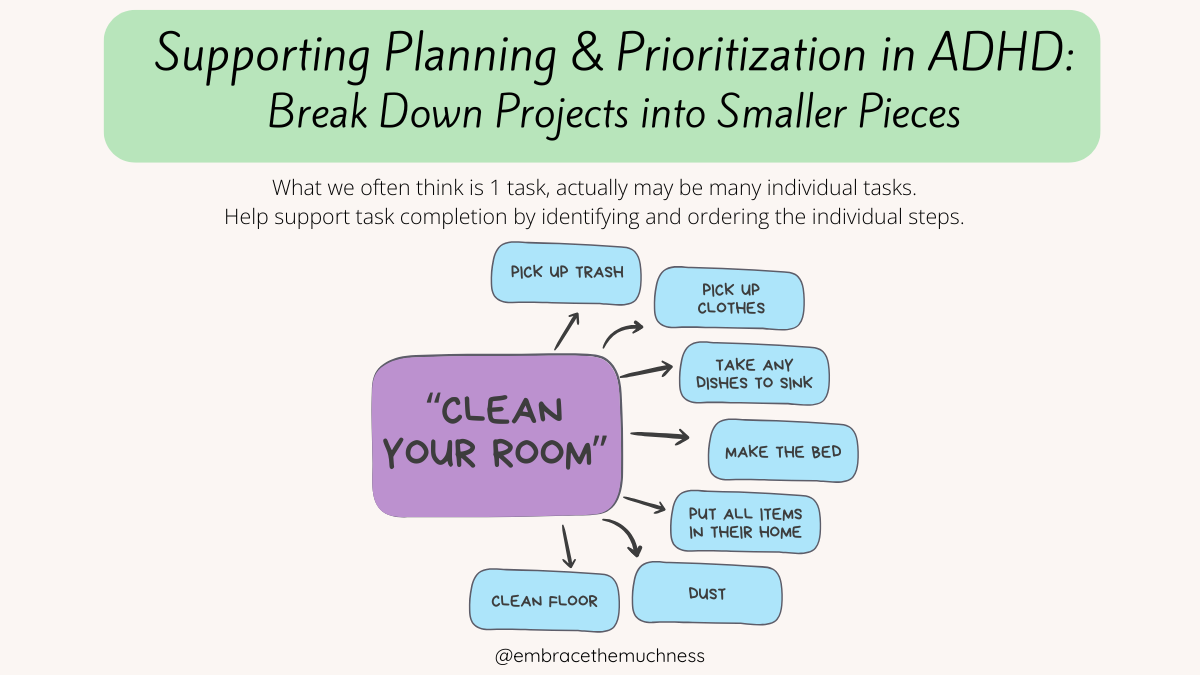
Help Break Projects Into Smaller Pieces
There are a number of common tasks that we talk about as if it’s one thing, when really it involves multiple steps to complete that one task.
Examples:
“Do the dishes.”
“Clean your room.”
“Do your laundry.”
You can be helpful by breaking these larger tasks into their smaller steps, and also help with the ordering of them.
With ADHDers, it’s often not effective to give multi-step verbal directions at one time and expecting them to complete a sequence of steps.
For young children, instead, give just 1 step of the instruction, have them complete it, and come back to you for the next step. For teens/adults, you can write out or have them write out each of the steps in a list they could take with them, to help remember and keep them on track.
If there are many steps - keeping the list to just a few at a time can help reduce them bumping up against nervous system overwhelm that tends to leave to task paralysis.
Help Identify the First Step
The difficulty isn’t always completing the task, it’s often deciding where to begin.
Questions that can help include:
“What will make the biggest visual impact?”
If cleaning a room, I like to start with picking up the largest items first
If handwashing dishes, I wash the largest bowls first
If folding laundry, I fold the towels and hoodies first
It gives me an immediate sense of accomplishment as I can see the workload diminishing.
"What would be the easiest to get started with?”
“Is there anything that MUST be done before we can do the rest of the steps?”
For ADHDers, getting started is one of the hardest parts. Momentum is very helpful, so getting them started can be immensely helpful.
Externalize the Plan
Planning is often much easier when we can see all of the components. It reduces the load on working memory.
Encourage using external supports such as:
Whiteboards
Sticky notes
Paper planners
Digital calendars
Task management apps
Shared family calendars
Visual project checklists
There doesn’t need to be one perfect system, the information needs to be available at the time and point of use.
Give Prompts to Help Prioritize
When everything feels important, picking which to do first feels impossible.
Sometimes it helps to ask questions like:
“What absolutely has to happen today?”
“What would you feel most relieved to have done today?”
“What has the closest deadline?”
“Which matters most to you right now? Saving money? Time? Meeting deadlines? Relationships? Conserving energy? Enjoyment? Something else?”
Once a value lens is chosen, ask, “Which task best supports this priority?”
Verbalize Your Own Decision Making Process
Many of the ADHDers I work with will tell me they truly feel baffled about how those without ADHD just seem to “know” what to do first or which decision to make. If you are fairly good at prioritizing, you can help the ADHDers around you strengthen their own skills by modeling your own decision making process.
Let’s revisit the task list shared in the Understanding Planning & Prioritization blog as an example:
Cancel streaming subscription
Schedule dentist appointment
Complete school form
Sweep the floor
Deposit check
Pay credit card bill
You have all these items that need to be completed today. Modeling your own prioritization process can look like stating the rationale for your choices out loud.
“I want to save as much money as possible right now, so I’m going to cancel our streaming subscription, so that I don’t get charged and then do a mobile check deposit. Then I’ll check how much we have left in our account and see if I can get the credit card bill paid off. I think I’ll sweep the floor after lunch so I can get all the crumbs, then I’ll sit down and call the dentist’s office before they close for the day and fill out the school form.”
While ADHDers do tend to do best when they lean into doing things in their own way, it can be helpful to have some reference points for how or why someone else might choose one thing over another if you truly feel like all choices feel equally important.
Reduce Decision Fatigue
Planning involves making dozens of small decisions.
The more decisions required, the more mentally exhausted you become.
Ways to reduce decision fatigue include:
Establishing consistent routines, so there’s no need to decide what order to do things in every time.
Keep frequently used items in the same place.
Prepare meals or clothing ahead of time.
Create templates or checklists for recurring tasks.
Develop standard routines for work, school, or home responsibilities.
It’s so much nicer to only have to make decisions one time and then simply carry out the plan from then on. (Again, making sure to have external reminders of the plans or routines helps reduce mental fatigue even further).
Support Verbal Processing
Many ADHDers are verbal/external processors. This means that they process and come to decisions most easily by talking through all the choices and pros/cons out loud rather than internal processors who do best reflecting on choices in their own mind.
As an external processor myself, I like to describe it feeling like multiple balls of yarn all tangled together in my brain, as I’m able to talk about each of the choices out loud, it feels like I can start to see the yard separate and get rolled back up into its own individual balls.
Your role in this situation isn’t telling them what to do, it’s holding space for them to process in the way they need to in order to come to their own conclusions.
Ask whether they want feedback or just want space to talk it through
Reflect back and summarize a few of the highlights you are hearing
Point out if you notice they seem drawn to or are discounting a particular option repeatedly
Pose a few reflection questions if it seems like they are not considering an important factor
Know that mentioning an option does not mean they are strongly considering it, sometimes we just need to simply name that something is A choice, that doesn’t mean we think it’s THE choice.
The differences between internal and external/verbal processing styles are not discussed much or well understood so these differences often cause a lot of relational conflict. Check out a previous article related to supporting external processing for more information.
Final Thoughts
Planning and prioritization are far more complex than simply “just make a plan.” They require coordinating multiple executive functioning skills simultaneously while managing distractions, emotions, time awareness, and cognitive load.
The most effective support involves taking on a collaborative role, rather than just doing it for them or telling them what to do. When we shift from judgment to understanding, we create opportunities for greater confidence, independence, and success.
Bobbi-Jo Molokken
ADHD Coach & Educator | Embrace the Muchness
*Be sure to check out all other blogs in our What the EF? Executive Functioning Series