
Gift giving is often talked about as a loving gesture, a way to show care, appreciation, or connection. What is discussed far less often are the unwritten rules that quietly govern gift giving. These rules are rarely stated out loud, yet they shape how gifts are chosen, received, interpreted, and judged.
For many people, especially Autistics, ADHDers, and those with trauma histories, these invisible expectations can turn a well-intentioned act into a source of stress, confusion, or shame.
This guide names some of those unwritten rules so you can better understand how others might view gift giving and what expectations they may be holding. Naming these rules does not mean you are required to follow them. Rather, if no one has ever explained these expectations to you before, having them articulated can offer context for other people’s reactions and support clearer communication about how you want to navigate gift giving.
In addition to broader societal expectations, each relationship system often carries its own unwritten rules. Families, workplaces, friend groups, neighborhoods, and cultures may all practice different rituals around gift giving. This layered set of expectations can make it especially difficult to know what is expected in any given situation.
Below are some of the most common unwritten rules of gift giving, along with ways to navigate them more gently.
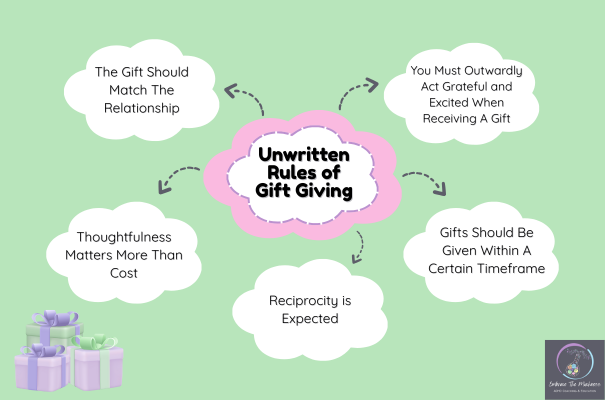
Unwritten Rule #1: “The Gift Should Match the Relationship”
The expectation
There is often an unspoken belief that the type, cost, and emotional weight of a gift should reflect how close the relationship is. Romantic partners, close family members, and best friends are typically expected to receive more thoughtful or meaningful gifts than coworkers, acquaintances, or extended family.
When a gift feels “too small,” it may be interpreted as a lack of care. When a gift feels “too big,” it can create discomfort or assumptions that the relationship is not viewed equally by both parties.
Ways to navigate this
It can help to check in directly about expectations. For example:
“I care about you and sometimes struggle with gift giving, so I wanted to check whether you’re expecting us to exchange gifts and, if so, what price range you’re comfortable with.”
This clarifies both whether gift exchange is expected and what feels appropriate.
If someone suggests a price range outside your capacity, you might say:
“I really appreciate how much you value our relationship. I wish I were in a position to spend that much, and right now I can manage around $_____. It’s not a reflection of how much I care, just what’s feasible for me financially. I hope that feels okay.”
Unwritten Rule #2: “Thoughtfulness Matters More Than Cost”
The expectation
People often say “it’s the thought that counts,” but what they usually mean is that the gift should show effort, attention, or personal knowledge of the recipient. A lower-cost gift can be deeply appreciated if it reflects the person’s interests or needs.
The challenge is that thoughtfulness is subjective. Even when someone genuinely tries, they may miss the mark. A gift can feel impractical, mismatched, or simply not resonate, even when the giver put in effort. This can be especially hard for those who are not naturally inclined toward guessing what others might find meaningful.
Ways to navigate this
When possible, anchor gifts to something concrete:
Keep a running note on your phone with gift ideas. Anytime someone mentions something they like or want, add it to the list for future reference.
Look for practical problems you could help solve. If they often mention not having enough chairs for guests, folding chairs might be appreciated. If they complain about food prep, a vegetable chopper could be helpful.
Use shared memories or inside references. A shirt with a quote from a favorite show, or tickets to recreate a meaningful shared experience, can feel thoughtful without requiring guesswork.
If you’re unsure, asking directly or offering choices can be relieving for everyone involved. For example:
“I’d love to get you something you’d actually enjoy. Would you prefer something practical or an experience?”
Or more directly:
“I’ve been told I’m not great at gift giving. Would you be willing to give me a short list so I can make sure I get you something you’ll like?”
This can also reduce pressure on the recipient related to the next rule.
Unwritten Rule #3: “You Must Outwardly Act Grateful and Excited When Receiving A Gift”
The expectation
Many people hold an unspoken hope that the recipient will respond with visible enthusiasm, gratitude, or excitement. When a response feels muted or neutral, the gift giver may interpret it as rejection or disappointment.
This expectation is often unfair to recipients. It can pressure them to mask their authentic reactions and may lead to being labeled “ungrateful” if they do not perform the expected response. Even when someone genuinely appreciates a gift, outward excitement may simply not come naturally.
Ways to navigate this
Recognize that this expectation exists and decide ahead of time how you want to handle it. Some people find it helpful to have a neutral, authentic response prepared, such as:
“I appreciate you thinking of me.”
This acknowledges the giver’s effort without requiring exaggerated enthusiasm.
If you are the gift giver, it can help to challenge assumptions based solely on outward reactions. Responses are influenced by many factors, including neurotype, nervous system state, and past experiences with gift giving. A lack of visible excitement does not necessarily reflect a lack of appreciation.
Unwritten Rule #4: “Gifts Should Be Given Within a Certain Timeframe”
The expectation
Birthdays, holidays, anniversaries, milestones, and even thank-you cards often come with unspoken timelines. A late gift may be interpreted as forgetting or not caring, even when life circumstances played a significant role.
For individuals with ADHD, time blindness and competing demands can make these timelines especially difficult to manage.
Ways to navigate this
External supports can help, such as calendar reminders or recurring alerts. Setting reminders well in advance allows time for shopping, creating, or shipping.
Be realistic about your capacity. Choosing a simpler gift that you can give on time is often received more positively than a highly personalized gift that arrives late or not at all.
When delays happen, honest communication can preserve connection. A brief message such as,
“I ordered a gift for you, but it’s going to arrive a little late,”
is often far better than silence.
Unwritten Rule #5: “Reciprocity Is Expected”
The expectation
Gift giving is often tracked over time, sometimes unconsciously. People notice who gives, who forgets, who spends more, and who reciprocates. Even when this tracking isn’t fully conscious, it can influence feelings of fairness or imbalance in relationships.
Ways to navigate this
Communication is key.
Discuss or set boundaries, such as agreeing to no gifts, experiences only, or low-cost limits.
Name when gifts are optional rather than obligatory, only when that is genuinely true.
Clear agreements reduce resentment far more effectively than silent scorekeeping.
Don’t Forget about the Executive Functioning!
Gift giving also carries lot of executive functioning. It requires:
Working memory to keep track of dates, preferences, and past gifts
Prioritization to help in deciding which gift to give
Time management and planning to determine when to purchase/create the gift in time for the occasion. You may also need a card and gift wrapping too!
Organization to keep track of where you store the gift until needed.
Task initiation to start the whole process
Emotional regulation when fear of disappointing someone or getting it “wrong” shows up
For many neurodivergent people, the sheer number of invisible steps involved can feel overwhelming. Many of the tips shared throughout this guide can help to reduce the mental load.
Moving Toward More Transparent Gift Giving
You do not need to follow all of these so-called rules. The goal is greater transparency and communication around expectations. Gift giving becomes more sustainable when it shifts from feeling like you are being graded on hidden criteria to a shared understanding of needs, values, and capacity.
Understanding these societal expectations allows you to decide when you want to follow them and when you prefer a different approach. What feels best may vary across relationships and contexts. Seeking clarity when needed can help you make intentional choices about how you want to engage in gift giving.
Bobbi-Jo Molokken
ADHD Coach & Educator | Embrace the Muchness
For additional information on this topic checkout these resources:
Autism & Gift Exchanges- Aces Up Your Sleeve Podcast Episode (Highly suggest listening to all their episodes, hosted by 2 AuDHD therapists)
Holiday Season Scripts - Short Reel from Neuron & Rose of scripts you can use to handle common holiday challenges
New Year’s Resolutions for ADHD - A Planning and Reflection Workbook for Finding Your Way - If you are reading this near the end of the year, you may also be thinking about gift giving and the holidays so might be interested in this workbook!