
What the EF? How to Support Time Management
A guide for parents, partners, relatives, friends, and professionals supporting ADHDers. Part of the What the EF? Executive Functioning blog series
Companion blog: What the EF? Understanding Time Management
Before we begin, if you haven’t already read our companion blog, we recommend doing so first and then returning here.
This article may contain affiliate links. If you purchase through these links, I may earn a small commission at no additional cost to you. I only recommend products and resources that I genuinely believe are helpful.
Why This Matters
After reading about how ADHD impacts time management, many parents, partners, and professionals walk away wondering:
“Okay… so how do I actually support this?”
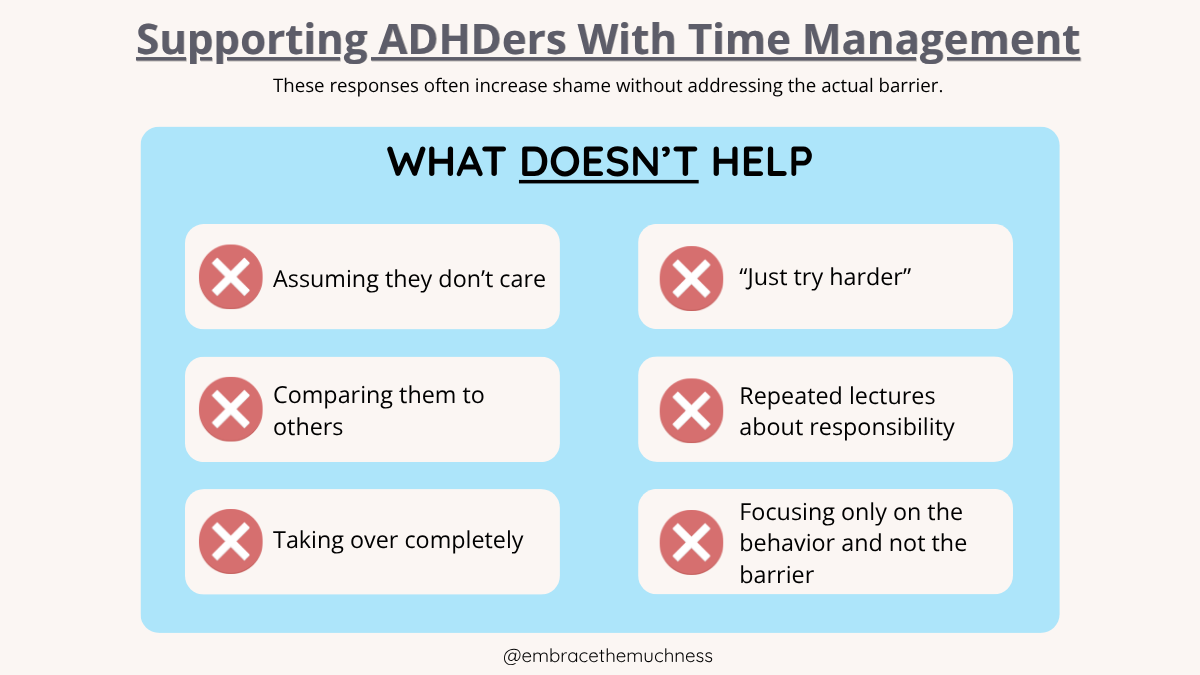
When someone consistently struggles with time management, the outside world often interprets it as laziness, irresponsibility, lack of effort, or “not caring enough.” If perceived in this way, it leads to frustration, disappointment, and hurt for others and shame for the ADHDer. In reality, many of these challenges stem from ADHD-related differences in executive functioning, including time awareness, time estimation, attention regulation, task initiation, working memory, and energy management.
Support becomes much more effective when we stop assuming that the issue is a lack of planning ahead, and we actually break down and consider what cognitive skills and information is necessary to effectively time manage.
Let’s talk about what actually helps.
Start with Curiosity Instead of Assumptions
One of the most supportive things you can do is become curious about why something is happening rather than immediately focusing on stopping the behavior.
Instead of:
“They’re always late.”
“They never manage their time well.”
“They wait until the last minute for everything.”
Try asking yourself:
What do I know about ADHD that might be getting in the way here?
Are they struggling to accurately estimate time?
Are transitions difficult?
Did they just lose track of time?
What other executive functioning skills beyond time might they be struggling with?
ADHD time management challenges are often much more complex than they appear on the surface.
For example, a child who is “slow getting ready” in the morning may actually be struggling with:
Remembering all the steps
Transitioning between tasks
Getting distracted by things in the environment
Estimating how long each step takes and when to switch
Locating the items they need to get ready due to organization and working memory challenges
Internally tracking how much time is passing
The more we can help to identify the specific barrier, the more effective the support becomes.
Avoid Moralizing Time Management
As a society, there’s a neuronormative expectation that everyone has the ability to consistently be aware of the time, estimate how long things take, and plan out their time well. Because of this expectation, judgments are then made about an individual’s character or values when they don’t meet that societal expectation.
As examples, when people are late, they are often told things like
“If it was important to you, you’d be here on time.”
“You don’t value me and made me waste my time waiting for you.”
“You are irresponsible because you are always late.”
When in reality, at the core of it,they may have significantly more difficulty tracking the passage of time and estimating how long things take. It’s a difference in brain processing (i.e. a disability) If you’ve found yourself thinking/saying these things, it makes sense because that is what the culture conditioning has taught us. If you live in a capitalistic society where time = money, then “wasted” time is seen as undesirable and disrespectful. While the pressure around this is very real, I invite you to pause and reflect on these larger societal norms and values. I know firsthand that it’s possible to shift what may feel like automatic judgments that arise. I’m writing this from the midwest United States, and came from a family where 10 minutes early was on time. It’s taken me many years to slowly shift away from automatic assumptions into curiosity when someone isn’t being “timely”.
Much of this shift started whenI had the opportunity to spend a semester abroad in Spain during college. It was then that I was able to realize that the moral judgments around time were not universal, rather were cultural. Planned meet up times were treated as approximate, and there was far less judgment attached to arriving late than expected. That experience helped me recognize that many of the moral judgments we attach to punctuality are learned rather than objective truths.
When we frame time management as a character issue instead of an executive functioning challenge, ADHDers often become more stuck, not less, as that messaging just increases further feelings of shame.
The goal is not removing accountability. The goal is reducing shame enough that problem solving becomes possible.
Understand That “Knowing” Isn’t the Same as “Doing”
This is one of the biggest disconnects I see in ADHD support.
Someone may:
Know the appointment is important
Know they should leave earlier
Know they need to start sooner
Know the deadline exists
…and still struggle to carry out the action required in the moment.
That’s because executive functioning is not just about knowledge. It’s about application of these mental skills.
This is why lectures, reminders to “just plan ahead,” or repeated criticism often don’t improve the situation. Most ADHDers already know what they’re supposed to do. The challenge is creating systems and supports that help bridge the gap between intention and action.
Externalize Time Whenever Possible
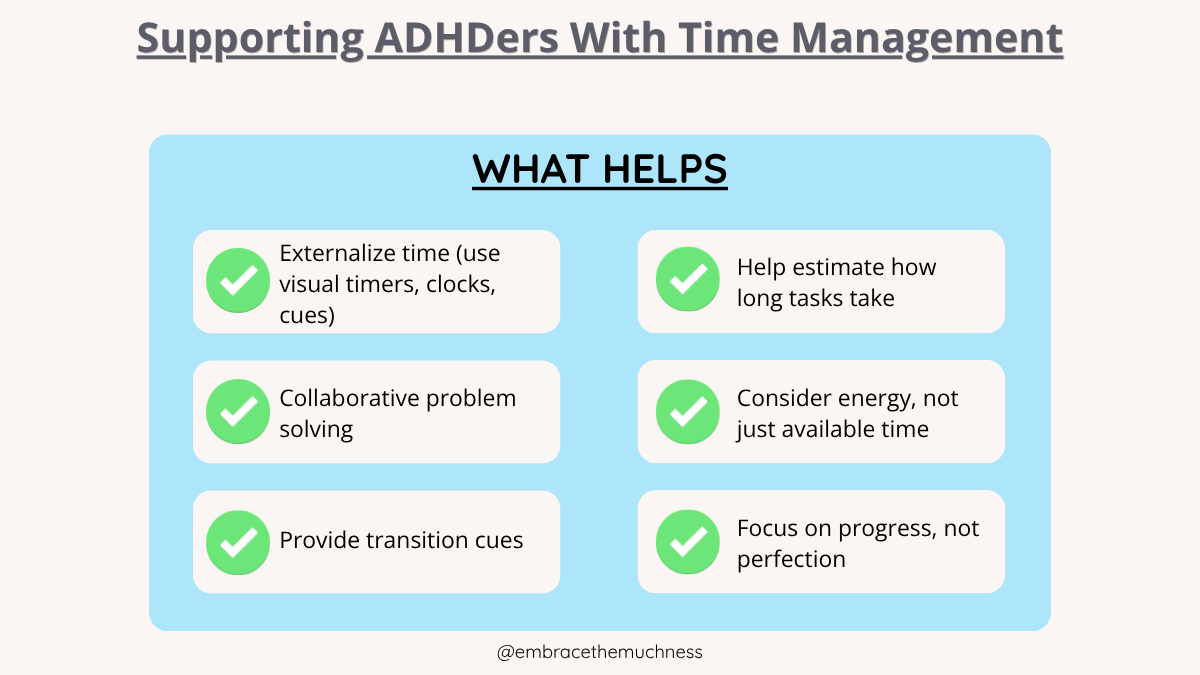
So what is helpful? One of the most helpful supports is making time visible and tangible.
Because internal time awareness is often unreliable for ADHDers, external supports that help orient to the current time can be very helpful.
This can include:
Visual timers (Check out Time Timer for a physical one or Free Timer for an app version for desktops. These are the ones I use regularly!)
Analog clocks easily visible in every room and from all angles
Phone alarms
Smartwatch reminders
Calendars with alerts
Verbal transition warnings
This can sound like:
“You have 10 minutes left, start wrapping up”
“It’s about 4 Blueys until we get there” - Children often don't have a meaningful sense of what "10 minutes" feels like. Sometimes it helps to translate time into units that are more familiar to them. When our youngest child asked how much longer until we'd arrive somewhere, we'd answer in Bluey episodes instead of minutes.
“We have 300 seconds until we need to leave.”- Different ADHDers respond to different ways of conceptualizing time. Some people find that converting time into seconds creates a greater sense of urgency than hearing five minutes."
“I’m going to start putting my shoes on since it’s time to leave in 5 minutes.” Using declarative language can orient others to the time without landing as a direct demand of them.
Remember That Energy Management Matters Too
One of the biggest mistakes people make is assuming that if someone has time available, they automatically have the capacity available too.
But many ADHDers experience significant fluctuations in:
Attention
Motivation
Mental energy
Physical energy
Emotional capacity
Someone may have two free hours available but lack the mental, physical, or emotional energy needed for a particular task. This doesn’t mean expectations disappear. It means we work with that person’s natural energy patterns instead of constantly fighting against them.
With tweens-adults, a helpful question to discuss with them is, “When, realistically, will you have the time and energy available to do X?”
In reflecting on the question, if the person you’re supporting presents an option that you know from observation is unlikely to actually work, you could reflect that back to them. (ADHDers also struggle with the executive functioning skill of self monitoring, so the skill of reflecting on patterns and then adjusting plans accordingly may need some support as well.)
“While I know you might have time to do that immediately after work, you also seem to be physically exhausted at that time, so I’m wondering how realistic it is that you’ll have the energy to complete this then?”
If you are supporting children, their brains may not be developed enough to notice those patterns, so it can be helpful if you can help to reflect on those patterns and plan out time in a way that aligns with the patterns you have observed.
As an example, over the years I’ve noticed that when we go on a trip, my ADHD children seem to need some recuperation time between big activities. So, rather than going from one big activity straight to another, we might plan to go back to our hotel after the first big activity, and take an hour of quiet time where we all play on our own devices, before heading out to activity number two, which can prevent overstimulation, irritability, and meltdowns.
Some general principles to consider:
Scheduling demanding tasks during higher energy/focus periods
Allowing recovery time between demanding activities
Reducing unnecessary demands
Identifying which types of tasks appear to restore vs drain energy
Sometimes improving time management is actually about improving energy management first.
Build Systems With the Person, Not Just For Them
It’s tempting to jump in and just take care of all the scheduling for them. However, collaborative problem solving works better than control. The goal is to involve the other person in the planning and provide scaffolding to gradually transfer more responsibility to the individual (with consideration given to age and individual capacity). Think of it as taking on more of a coaching role, rather than telling them what to do, you want to work towards building independence, with you providing support as needed.
Instead of: “You need to use this planner.”
Try:
“I’ve noticed you have a hard time remembering when all of your activities are, can we talk about what system might work best to help you track it all?”
“What have you noticed works best for you?”
“What makes it hard to keep up with planners?”
“Would visual reminders, alarms, or checklists work better?”
The “best” planner, app, or organizational system is useless if it doesn’t match what that particular individual needs and prefers.
Bringing It Together
Time management challenges are often frustrating for everyone involved, including the ADHDer. While the underlying differences in time awareness and estimation may not disappear, supportive systems, collaborative problem solving, and realistic expectations can make a meaningful difference. The goal is not perfection. The goal is helping someone build strategies that allow them to function more effectively while respecting how their brain works.
Bobbi-Jo Molokken
ADHD Coach & Educator | Embrace the Muchness
*Be sure to check out all other blogs in our What the EF? Executive Functioning Series