
What the EF: Understanding Time Management
Part of the What the EF? Executive Functioning blog series
When most people hear “time management,” they think of planners, calendars, and color-coded schedules. But that’s only the surface. At its core, “good” time management requires being able to accurately estimate how long each task will take, and for many ADHDers, that’s where things start to get complicated.
Time isn’t something we can see or hold. It’s abstract. And when your brain already has difficulty regulating attention, motivation, and emotion, time can feel slippery and elusive.
Let’s break it down.
Time Management Isn’t Just Scheduling
In order to be able to “schedule” yourself well, you have to be able to answer questions like:
How long will this task take?
How much time do I have available?
How long do I need to transition to my next task?
How long will the tasks before and after this take?
If any of those estimates are off, the whole plan can unravel.
Many ADHDers experience challenges with time awareness, which is an internalsense of how much time has passed. They also often struggle with time estimation, the ability to guess how long something will take. The combination of these means time management can be very challenging.
The “On/Off” Switch and Time Distortion
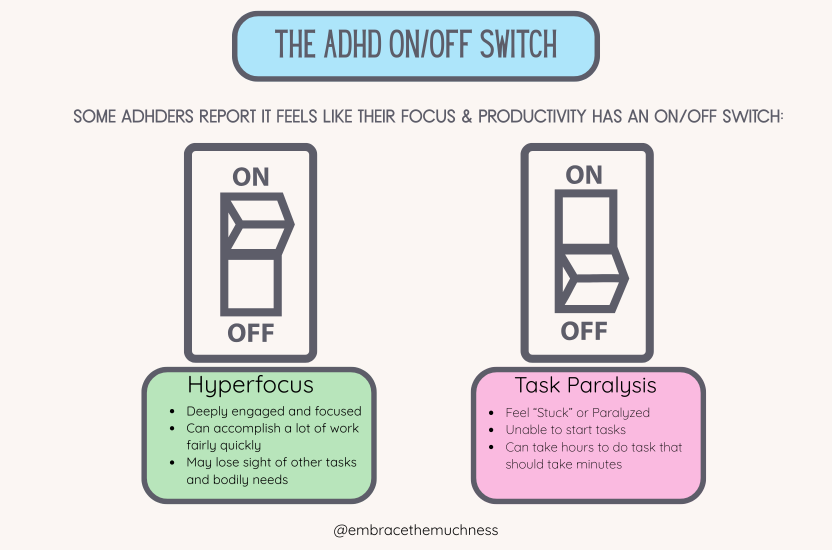
ADHD often feels like it comes with an on/off switch when it comes to focus, as opposed to a dimmer switch where there’s adjustable levels.
“On” = Hyperfocus: where hours can pass unnoticed while you’re deeply engaged, accomplishing an incredible amount of work
“Off” = Task paralysis or distraction: where you could be stuck, unable to start any task, or what should be a 10-minute task might take hours, days, or even weeks to complete because of constant distractions and interrupting thoughts or impulses.
This constant variability makes it even harder to accurately predict how long a task will take. If the same task can take 10 minutes one day and 2 hours the next, how do you plan for it?
ADHDers also have a tendency to overestimate how long unpleasant tasks will take (i.e. telling yourself it’ll take an hour to call and schedule an appointment when it actually takes 10 minutes) and to underestimate how long pleasant/enjoyable tasks will take (i.e. telling yourself it will only take 1 hour to complete 1 step on a project of your favorite hobby, but you are still there 3 hours later, still working on it.
Over time, this inconsistency can lead to an overall lack of self-trust. This only makes attempting time management even more difficult because then we question and second guess ourselves, and will often move into avoidance of time planning at all.
Time Agnosia (Often Called “Time Blindness”)
You may have heard the term “time blindness.” This is used to refer to the experience of “not seeing” time. Some individuals in the blind community have requested a different term be used, and so time agnosia can be used instead to describe this experience.
This is what it can look like in real life:
You’ve got 15 minutes before a meeting. You think, “I’ll just send one quick email.”
You look up… and it’s now 5 minutes after your meeting started.
That’s not carelessness. Your brain just doesn’t feel or notice the passing of time in the same way that non-ADHDers seem to. This is another factor that makes time management challenging, as even when you do plan out your time, you may be likely to lose track of it, spending more time on a task than intended and throwing off the plan for the rest of the day.
Identifying Your Natural Energy Patterns
Neurotypical time management is usually just identifying a block of time that’s open, how long that task takes, and boom, plan made! However, for many ADHDers like myself, just because I have a block of time open doesn’t mean that I’m able to do THAT kind of task at THAT particular time of day. It’s really helpful to reflect on when in your day you tend to have the most energy and focus, when you tend to be most likely to complete physical tasks, mental tasks, or self-care tasks (and when you never will be likely to do that type of a task).
Managing your time in a way that includes your body’s natural patterns will increase your chances of being able to carry out that plan.
For example, I’m free from 10pm - 12:00am every night, as my body won’t let me go to sleep before midnight, and the rest of my family is in bed. However, for years, I’d tell myself that I would get tasks done during that time frame, but the reality is by that time in the day, I’m generally physically and mentally exhausted. So, rather than continuing to plan to get things done then, and then feeling shame when I inevitably didn’t, I simply accepted that this is my restoration time and I just no longer plan to get any tasks done during that time frame and look to other times of day when I do tend to have the right kind of energy to complete those tasks.
Accommodating your own needs and incorporating that into your time planning can significantly shift how your relationship with time management feels. It might be helpful to reframe it to “time and energy management”.
Time Management Is Connected to Other EF Skills
While time management is recognized as its own executive functioning skill, this skill directly involves other skills
Working memory: remembering how long tasks take or what steps are involved or when to do them
Planning & prioritization: deciding what to do, in what order, and when
Organization: keeping track of all commitments and tasks that need to be scheduled, or when they have been scheduled
Task initiation: actually starting within the time that was planned
Metacognition: being able to think about and reflect on our own patterns and our internal experiences, what’s worked or not worked for us before
For example:
If you forget steps in a task, you’ll underestimate how long it takes and then either have to stop before it’s finished to transition or take longer, throwing off the rest of the day’s schedule.
If something isn’t written in your calendar, you may schedule yourself for 2 commitments at the same time.
If you struggle to prioritize, everything can feel equally urgent and you may end up spending time on one project when another truly needs to be done first.
All of these pieces interact, which is why time management challenges can feel so layered.
Don’t Forget the Hidden Steps (Transitions Matter)
When someone struggles with getting to places on time, one of the first things I look at is whether they are accounting for all of the steps of that task, especially transitions.
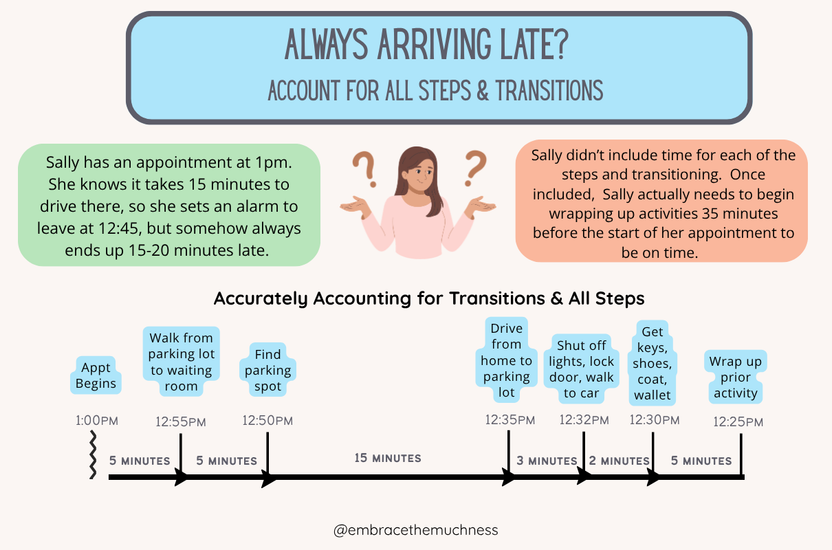
Let’s say a person has a 1:00 PM appointment and is chronically late. Once we dig into what’s getting in the way, much of the time, I’ll find that they are only accounting for the drive time (15 minutes) so they plan to leave at 12:45pm, but end up late every time.
Why? Because the drive isn’t the only step.
You also need time to:
Wrap up what you’re currently doing (5 minutes)
Gather your things (keys, wallet, paperwork, jacket - 2 minutes)
Close up the house & walk to the car (secure pets, turn off lights, lock the door - 3 minutes)
Drive (15 minutes)
Find a parking spot & park (5 minutes)
Walk inside & check in (5 minutes)
In the example in the graphic, when we account for all of these steps, we actually have to start wrapping up 35 minutes before the start of the appointment to get there on time.
All of these are just patterns that are completely typical for folks with ADHD brains that simply experience time differently and may also struggle with the other connected executive functioning skills as well. But, what can we do about it to support ourselves in a world that highly values being on time and efficient with time?
Strategies That Actually Help
There are a number of strategies one can use to improve your time management.
Time Your Tasks (Build Your Own Data)
1.Make a list of the repetitive tasks you complete and actually time yourself doing them. Put these into a note on your phone.
Over time, you’ll create a personalized reference list:
Putting Laundry Into Washer/Dryer: 10 minutes
Total time to wash and dry a week’s worth of laundry: 8 hours
Folding and putting away laundry: 30 minutes
Loading/Unloading dishes in dishwasher: 10 minutes
For myself, doing the above significantly changed my relationship with these tasks. Prior to timing myself, I thought it took 1 hour to fold and put away laundry. Because my process for doing that is sorting multiple piles onto my bed for myself and each of my kids, I can only really do that in the evenings and had to be done before 9pm when my partner went to bed. Between making and eating dinner and baths/bedtime routine, rarely would I have an entire 1 hour block open to complete this task. Once I timed myself, it was only 30 minutes and it’s much more doable for me to be able to find a 30 minute block in an evening to get this task completed. Prior to timing myself, I thought loading/unloading the dishes took 20 minutes, when I found out it was only 10, I realized that I often do have a 10 minute break between client appointments on the days I work from home, AND that I’m usually needing to get up and move around and also do something that doesn’t require a lot of mental energy, so now I’m able to view this task as a good way to get my needs met rather than a chore I absolutely dread.
2. Use Your Short Windows Intentionally
Once you have your list of tasks and how long they take put together, whenever you find yourself with a short block of time before doing something else, ask yourself:
What can I reliably complete in less than 10 minutes? Look at your note and see what task that needs done could be completed in that time.
Often, because subconsciously we are aware of our time agnosia, we don’t want to start a task if we don’t know how long it will take as we worry we won’t leave on time. If you know you can reliably complete a task in the window you have, it removes the barrier to task initiation.
Externalize Time
Internal time awareness is unreliable, so bring it outside your brain.
Visual timers (such as Time Timer)
Phone/home assistant notifications or alarms
Smartwatch alerts
These create a visible or audible cue about how much time has passed. This can alleviate that fear of losing track of time and can help increase your awareness of how much you can realistically accomplish during a set time period.
Include Transitions when Planning
When scheduling something, ask:
How much time do I need to transition out of this and into the next thing?
Then calculate backwards adding the time for each step, and set your alarm for the start time of the transition, not just the event itself.
Use Multiple Alarms to Help With Transitions
Some find it helpful to use multiple alarms to signal each transition you should be making.
Example:
One to signal time to start wrapping up
One set 5 minutes later to indicate you should have shifted to get ready for the next task
One set 5 (or however long you’ve timed) minutes later to indicate you should be walking out the door
Capture Everything in One Place
If it’s not written down, it’s easy to lose track of it. Using 1 consistent calendar or task system helps reduce the working memory load and keeps your plan visible. It also prevents double scheduling.
I generally recommend using an electronic calendar as opposed to a paper planner, just because you’re more likely to always have your phone with you and may not always have a planner with you at all times. Digital calendars also allow you to set audible alerts.
However, do what works best for you! If you are a paper planner person or prefer some other type of calendar system, that’s totally fine. You just might want to come up with a system to remember to bring the planner with you anytime you go to appointments or may need to schedule or can have some system to make sure you are regularly remembering to go into the paper planner to update it.
Consider Your Natural Patterns
When putting together a plan, ask yourself a few questions to help determine when it might be best to complete a task.
What type of energy does this task take? (Physical, mental, emotional, social)
How long will this take?
When in my day am I most likely to have this kind of energy available?
When do I have time available at that time of day to attempt this task?
If your availability and “best chance” times don’t align you might have to come up with the next best chance. If you start to realize that your patterns show there is a small window of optimal time to complete a particular task, then you may have to work to protect that time for that task, even if the task itself isn’t the highest on your priority list. Again, our ADHD brains work differently and how we prioritize our time may be based on our capacity needs.
Bringing It Together
Time management isn’t about just plopping tasks into open blocks of time. It’s about understanding how your individual brain experiences time and building systems that support that reality.
When you start to:
Gather real data about how long things take you on average
Account for transitions
Use timers/alarms
Connect planning with your energy and attention
…time begins to feel a little less chaotic and a little more intentional. It’s not going to be perfect, and even when you use your best skills to plan and manage your time, life can still throw uncontrollable surprises at you that derail your plans. But, it will feel better overall once you feel like you are intentional about how you spend your time.
Bobbi-Jo Molokken
ADHD Coach & Educator: Embrace the Muchness
*Want to learn about other executive functioning skills? Check out the other articles in our What the EF? series
*Looking for products to help with time management? Check out our Tech & TIme Management Product Recommendations