Why Can’t I Get Anything Done? Living and Functioning in Overwhelming Times
There are moments when the question “Why can’t I get anything done?” feels less like frustration and more like genuine confusion. You might know what needs to be done. You might even want to do it. And yet, it feels harder than usual to stay focused, harder to start, and harder to see things through until they’re finished.
Sometimes though, it’s not you. It’s that you’re having a completely normal reaction to a world that feels like it’s burning all around you.
Whether it’s political and social justice activity, major weather events or natural disasters, infectious disease spread, or something else entirely, the common thread in all of these situations is a threat to our sense of safety AND feelings of uncertainty/instability.
*If you’re reading this in early 2026, it makes absolute sense you might be experiencing this. In the US, we’re seeing fellow citizens being murdered by law enforcement officers. We’re often watching these very traumatic videos multiple times from multiple angles, only to be told by the government that what we are seeing with our own eyes isn’t what happened. Oh, and there’s extreme cold temperatures and uncharacteristic snow/ice storms across the country at the same time. If you’re not “functioning” at whatever level is “normal” for you right now, that experience is completely expected when we look through a nervous system lens.
You Can Compartmentalize Your Thoughts, Not Your Nervous System
Despite these deeply upsetting events occurring, there’s often external circumstances (finances, school systems, etc.) that require us to keep moving along with our typical daily routines. As hard as we may try to compartmentalize as we move between the many roles we play in our lives, we can’t set aside our body’s nervous system. We may be able to push thinking about these distressing events to the back of our minds for a while, but that doesn’t mean your nervous system is shifting into a calm/regulated state.
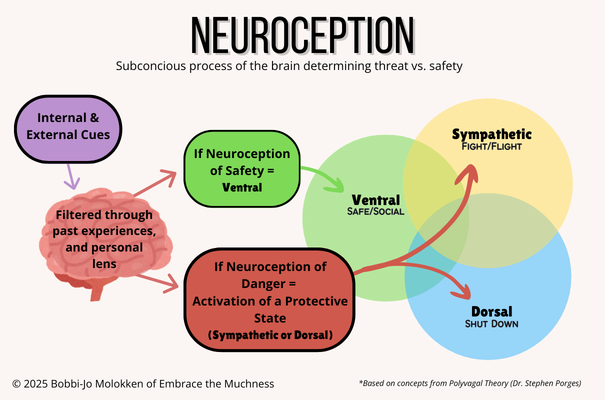
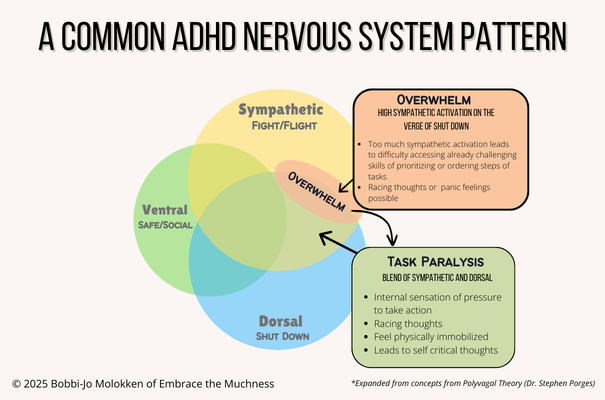
When we perceive any kind of threat to our physical or social safety, our nervous system automatically shifts into a protective state. This can look like a fight or flight response, where the body produces extra energy to help you respond to the perceived threat to safety, or a shutdown response, where the body slows things down to conserve energy and help you survive. There can be a wide range of intensity within each of these states. Also, it’s possible to experience a blend of both states simultaneously.
All of this happens subconsciously. We don’t actively choose whether we get activated, and we don’t choose which protective state we enter. This is the autonomic nervous system doing exactly what it’s designed to do, keep us alive. The brain doesn’t consult with the logical part of you prior to choosing a protective response. Additionally, once you are in a protective state, it’s harder to access the part of your brain responsible for logical thinking and executive functioning skills.
Why the World Around You Will Always Effect You
24 hour news cycles and the ability to see livestreams of terrifying events as they’re happening, often before there’s any sense of resolution, will move us into a protective state. This can happen even when there’s no immediate, direct threat to our life while we’re watching from the safety of our own living room.
Our nervous systems are also highly influenced by the nervous systems of other living beings. If the people around you are anxious, angry, shut down, fired up, or hopeless, that can have a subconscious impact on your own system as well. Given that, even if you were to attempt to protect your own exposure to these events, you’re still likely to be influenced by the nervous systems of the people around you who are taking in this kind of content. Unless you’re living in the woods completely off the grid, you can’t control whether a TV is turned on when in a waiting room for an appointment, or what the people next to you in line at the store are discussing. And, even if you’re someone who is pleased by seeing the suffering of others, that’s still your nervous system having a response to the events around you.
Why Overwhelm Makes It Hard to Get Things Done
Access to our executive functioning skills is deeply connected to the nervous system. These skills help us plan, initiate tasks, manage time, regulate emotions, shift attention, and stay flexible.
When your nervous system shifts into a protective state, safety and survival move to the forefront. Focus, follow through, and productivity move to the background. We are simply less able to access executive functioning skills when the nervous system is prioritizing protection. If a bear is running at you to attack you, in that moment you don’t need to be able to set short and long term goals, create a schedule or organize, you simply need to be able to run or fight. While in modern times most of us aren’t dealing with bear attacks on a daily basis, the body responds the same way whether the “threats” our brain perceives are physical or social.
For those of us with ADHD, executive functioning skills can be challenging even when we are well regulated. When we’re not regulated, accessing those skills becomes even harder. Think of it like the executive functioning skills being on medium or hard mode for an ADHDer, and then on extra hard mode when dysregulated.
How This Can Show Up Day to Day
When experiencing dysregulation, this might look like increased difficulty remembering things, such as what you were just about to do. Time can feel even more distorted, either dragging painfully slow or slipping away without warning. Prioritization becomes harder, with either nothing or everything feeling urgent. Flexibility narrows, making interruptions or changes feel unbearable rather than mildly inconvenient.
You might feel frozen, scattered, or constantly behind. Some people notice themselves stuck in cycles of doomscrolling or hyperfocusing on distressing information. Others swing between urgency and shutdown. Some feel numb or disconnected, which can look like apathy from the outside but is often a subconscious protective response, not a reflection of how much they care.
The Story We Tell Ourselves Makes This Harder
When we don’t understand our automatic nervous system responses and their impact on executive functioning, it’s easy to compare ourselves to past versions of ourselves and assume something is wrong. We tell ourselves we should be able to push through, stay focused, or function normally because we’ve done it before.
Executive functioning is not static. It fluctuates based on stress, energy, emotional load, and perceived safety. When the world feels overwhelming, expecting your brain to operate optimally is unrealistic.
It’s also important to name that living in a capitalist society compounds this in significant ways. When productivity is treated as a measure of worth, and time is equated with money, capacity is no longer allowed to fluctuate without consequences. There is often a constant, underlying pressure to perform, produce, and function on demand, regardless of what the nervous system is carrying.
For many people, the consequences of not being able to produce work on demand are not abstract. There can be very real fears around housing, food, healthcare, and basic stability. When survival needs are tied to productivity, the nervous system stays on high alert. That ongoing pressure makes regulation harder, which in turn makes executive functioning less accessible, creating a cycle that is often misinterpreted as a personal failure rather than a predictable response to systemic stress.
In this context, self-judgment tends to grow louder. Struggling to focus or follow through isn’t just frustrating, it can feel dangerous. Naming this broader reality matters, because the issue isn’t a lack of effort or discipline. It’s a system that demands consistency from nervous systems that are not designed to operate that way.
Regulation Comes Before Productivity
Supporting executive functioning during times like these often requires a shift in approach. Before focusing on optimization or productivity, we have to focus on regulation. Regulation gives us the best chance of accessing executive functioning skills. For those of us with ADHD, those skills may still be challenging even when regulated, but regulation always improves the odds.
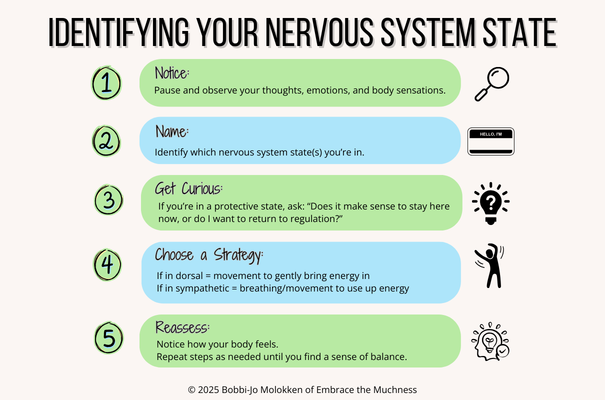
While we can’t always stop our bodies from entering protective states, we can work on noticing which state we’re in, evaluating whether we want to stay there, and, when possible, attempting to shift toward regulation.
It’s important to be clear here. If you are under an immediate threat to your safety, your body is going to remain in a protective state until that threat has passed. If a hungry bear is walking toward you with its claws out, taking a few deep breaths is not going to bring you into regulation. Your body is doing exactly what it should.
Shifting Toward Regulation When There Is No Immediate Threat
When we notice we’re in a protective state and there isn’t an immediate threat, we can attempt to support regulation.
If you’re in a fight or flight state, feeling anxious, angry, irritable, worried, or keyed up, the goal is often to help the body release that excess energy. Gentle movement, tensing and releasing muscles, stretching, or walking at a moderate pace and gradually slowing can help complete that stress cycle.
If you’re in a shutdown or immobilized state, feeling zoned out, frozen, slowed down, or disconnected, the goal is to gently bring energy back into the body. Slow, intentional movement that gradually increases can help wake up the nervous system and support a return to presence and steadier breathing.
If it’s available to you, finding co-regulation (being with another person who is in a regulated state) can also be very helpful. Just like we are subconciously impacted by other people’s nervous systems’ when they are dysregulated, we’re also subconciously impacted by them being regulated. Simply sharing space with someone who is calm and regulated cues to our own nervous system that it is safe and can help us return to a regulated state. (Psst…this is one reason why body doubling is effective!)
Doing Less on Purpose
When the world feels overwhelming, the goal is not to function as if nothing is happening. The goal is to create more moments of regulation when and where you can.
If you need to get some things done, regulation becomes the first task. If you find yourself struggling during times of uncertainty, that is completely normal. It does not mean you are failing, regressing, or losing skills. It means your system is responding appropriately to the context it’s in.
Executive functioning challenges during overwhelming times are not something to override or push through. They are information. They tell us that support, gentleness, and adjustment are needed.
Sometimes that means doing less, moving slower, and redefining what “enough” looks like. At the very least, it means recognizing that beating yourself up for what you’re not doing isn’t helping. Access to executive functioning tends to return not through pressure, but through safety, compassion, and room to breathe.
Bobbi-Jo Molokken
ADHD Coach & Educator | Embrace the Muchness.
If this resonates and you’d like to learn more about nervous systems and ADHD check out my innovative Rooted Regulation: ADHD Nervous System Toolkit, which offers educational graphics and explanations about the nervous system and common ADHD nervous system patterns. It includes worksheets and ideas of regulation strategies. Available with personal use rights or professional use rights. Mental health professionals also have the option to purchase a version with a training video and several bonus resources.
*Check out the What the EF? Series of blogs to learn more about executive functioning skills