
What the EF? Understanding Working Memory
Part of the What the EF? Executive Functioning series
Working memory…what does that even mean? For many ADHDers, it feels like our memory is certainly not working.
The term “working memory” refers to the cognitive skill of temporarily storing and manipulating information. It’s considered one of the core executive functioning skills.
What Working Memory Actually Is
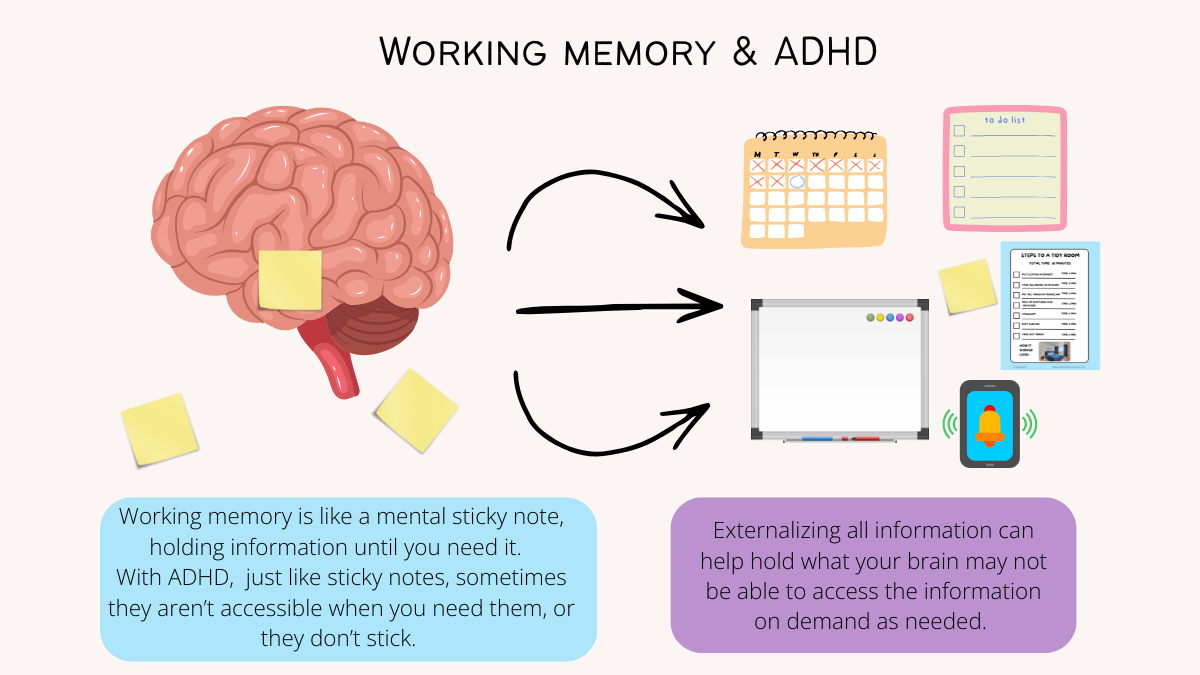
Think of working memory like a Post-it note in your brain. It holds information briefly until it’s needed.
Examples include:
Remembering the next step in a set of instructions
Holding a phone number in mind while dialing it
Keeping track of what you were about to say mid-sentence
Holding a task in mind that you need to complete later while working on something else
Remembering where you put the paper you need to turn in
Working memory is different from other types of memory:
Short-term memory involves briefly holding information without actively using it
Long-term memory is where information is stored more permanently over time
That said, while most academic sources focus specifically on working memory in ADHD, anecdotally I find that many ADHDers report challenges with short- and long-term memory as well. From a functional perspective, it can be more helpful to assume memory as a whole may be less reliable, rather than focusing on which specific type is impacted.
ADHD & Its Impact on Memory
A helpful way to understand ADHD is as a neurological difference that affects regulation…regulation of attention, motivation, interest, emotion, and behavior. All of these influence executive functioning.
Because of differences in attention regulation, ADHD brains often vacillate between:
Scanning everything in the environment and taking in too much at once
Focusing intensely on one thing and missing everything else
This impacts how information is encoded, stored, and retrieved.
It can look like:
KNOWING you need to join a meeting at 2:00pm, but becoming hyperfocused and losing track of time
Reading cooking instructions, completing one step, then immediately needing to reread them
Walking into a room and forgetting why you went there
Agreeing to complete a task, then not following through
The phrase, “out of sight, out of mind” is frequently used when referring to how ADHD brains work. If we can’t see it, its as if it doesn’t exist. Sometimes, people incorrectly conflate this with difficulties with object permanence, but that’s not quite the right term. Object permanence is the developmental skill when
I also believe this impacts the formation of longer-term memories.
Imagine you’re at Disney World with your family. While on a ride, your brain starts analyzing plot holes in the story instead of staying present. Because your attention is split, the experience may not fully encode into memory…so it’s less likely to be stored long-term.
Just like we see these memory orbs getting whisked away in Disney’s Inside Out!
“Out of Sight, Out of Mind”
The phrase, “out of sight, out of mind” is frequently used when referring to how ADHD brains work. Sometimes, people incorrectly conflate this with difficulties with object permanence, but that’s not quite the right term. Object permanence is a developmental skill that emerges in infancy, it refers to understanding that something still exists even when it can’t be seen. This isn’t what’s happening for ADHDers. It’s not that the object or information is believed to no longer exist, it’s that it’s no longer actively being held in awareness.
This is more accurately a working memory and attention-related experience. If something isn’t visible, recently engaged with, or externally cued, it can easily fall out of the mental “holding space.” That might look like forgetting about items tucked away in a drawer, not thinking about a task once it’s no longer in front of you, or losing track of something you intended to come back to.
Understanding this difference matters, because it shifts the response. Instead of assuming something has been forgotten due to carelessness, it points us toward support strategies that bring things back into view, literally or visually, so they can be re-accessed.
The ADHD Tax
Working memory challenges often come with real financial costs…commonly referred to as the “ADHD tax.”
Examples include:
Food going bad because it was forgotten
Forgetting to cancel free trials
Buying something you already own
Misplacing items and replacing them
Missed appointment fees
Missing return windows
Late registration fees
Many of these trace back to working memory breakdowns.
Relational Costs
The impact goes beyond being financial, it’s relational. There’s a common (often unspoken) belief in our society: “If it’s important to you, you’d remember.”
Because of this subconcious neuronormative expectation, when an ADHDer forgets something: a birthday, a task, a commitment…it’s often interpreted as not caring. It’s important that we all work on challenging this ableist belief. Remembering something on demand is not directly correlated to how important it is. I can promise you that when I’ve been literally on the way to pick up my child, and a seperate thought pops into my brain and I briefly forget and drive a couple blocks past my turn and then have to loop back around, that it’s not because I don’t care about my child.
Working memory isn’t about how much something matters. It’s about whether the brain can retrieve that information at the exact moment it’s needed. There’s unfortunately no override switch where importance guarantees recall. Most ADHDers deeply wish that were the case.
So What Do We Do About It?
Research has not consistently found ways to increase working memory capacity.
A meta-analysis by Monica Melby-Lervåg and Charles Hulme found that while some brain training programs show short-term improvement, those gains often don’t last, nor do they reliably transfer to real-life tasks. We are seeing many brain training games, who have a product to sell you, that are doing “research” and touting positive results, however you need to look more closely at what they are actually measuring, whether there’s long term retention or any supposed benefits, and whether the subjects are just getting better at playing that particular game, or if there’s an actual broader transfer of the skill to every day life. In other words, getting better at a memory game doesn’t necessarily help you remember your appointments. With that in mind, the most effective approach is not trying to “fix” or increase your memory…but using strategies to support your memory challenges.
Support Strategies and Accommodation Options
The primary approach to supporting working memory issues is to externalize all information you’ll need to reference later. The information must be available at the exact time and location it’s needed to complete the task.
If you struggle with working memory, one of the most helpful shifts is accepting that you may not be able to rely on memory alone…and building systems around that.
Some options to experiment with:
Alarms or timers for time-specific tasks
Writing instructions down
Keeping checklists where the task actually happens
Using visual cues (e.g., placing an item by your keys)
Breaking tasks into single steps
Automating whenever possible
And just as important, building compassion for when strategies don’t work. Initiation and completion of a task requires multiple executive functioning skills. Using these strategies may help you remember the task needs to be done, but we still need the rest of our EF skills to be in order to get the task completed. That’s “feedback, not failure. “
Example:
You set an alarm for an appointment, but still arrived late.
The alarm problem solved for the working memory challenge, but without having proper time estimation, planning, and accounting for each step of the transition, you might still end up late. Maybe you only calculated the drive time and forgot to add include the steps of closing down the house, parking, and walking inside.
I call this process, “leveling up” our skills. We refine and add one more piece to get closer to where we want to be.
Key Points About Working Memory
Things go more smoothly when you accept your memory may be inconsistent and you need to externalize information
This isn’t something you can “just try harder” at
There’s always going to be some bumps along the way when the strategies rely on the person with working memory challenges to remember to use the strategies. Perfection isn’t realistic.
When you can shift from:
“Why can’t I remember this?” to, “What do I need to do to remember this?”…things start to change.
Working memory challenges are not a personal failure. They reflect differences in how the brain processes and retrieves information. While we can’t fundamentally change that, we can build supports that make life easier.
Bobbi-Jo Molokken
ADHD Coach & Educator | Embrace the Muchness
*If you support someone with ADHD, check out What the EF? How to Support Working Memory to better understand how you can help support the ADHDer without you always having to be the external cue.
*To learn more about an overview of all of the executive functioning skills and how they are impacted by ADHD,
*Check out our Digital Downloads for some executive functioning supports!
*Interested in products to support your working memory challenges? Visit the ADHD Product Recommendations page.