A Guide to Finding a Neurodiversity-Affirming Assessor
You’ve probably been here before. Typing “autism assessment near me” or “ADHD evaluation for adults” into Google… and immediately feeling a mix of hope, dread, and please don’t let this be another person who doesn’t get it. Maybe you’ve been dismissed before. Maybe you’ve been told you’re “just anxious.” Maybe you’ve gotten really good at explaining yourself in a way that makes other people comfortable—but leaves you feeling wildly misunderstood. Maybe you’ve spent years in therapy trying to fix something that never quite made sense in the first place. And now you’re here wondering if this could be the missing piece… while also bracing yourself for the possibility that it won’t be.
Let’s say this part clearly: the assessment process can be clarifying, empowering, and genuinely life-changing… or it can feel like you’re being reduced to a checklist by someone who met you 12 minutes ago. And those are very different experiences. The good news is that you are not stuck with whatever provider happens to have the first opening. You actually get to choose someone who understands neurodivergence—not just in theory, but in practice. This guide is here to help you do exactly that.
What does Neurodiversity-Affirming Actually Mean?
So what does “neurodiversity-affirming” actually mean in real life, beyond the buzzword? At its core, it’s the difference between asking “how do we make you more normal?” and asking “how do we understand your brain and help you build a life that actually fits?” Traditional assessment models tend to focus on deficits, impairments, and how far you are from some imaginary baseline of typical. If you’ve already spent your life feeling like you’re too much, not enough, or somehow fundamentally off, that framework tends to reinforce the exact narrative you’re trying to untangle. Neurodiversity-affirming care flips that. It recognizes that your brain isn’t broken, your experiences are valid, and context matters—a lot. That context includes masking, burnout, identity, environment, and the very real ways you may have adapted in order to survive in spaces that weren’t built with you in mind.
A good assessment isn’t about catching you being autistic or ADHD. It’s about understanding how you move through the world, what’s been missed or misunderstood, and what it has cost you to function the way you have. When people finally land in an affirming process, one of the most common reactions is some version of, “Wait… that counts?” or “Oh. That explains everything.” Not in a simplistic, reductive way—but in a way that suddenly organizes years of confusion into something coherent. Done well, assessment gives you language, context, and direction. Done poorly, it can leave you feeling like you somehow failed a test about your own brain.
Part of why this process can feel so high-stakes is because so many people were missed in the first place. There’s this assumption that if something like autism or ADHD were present, someone would have noticed earlier. But that assumption falls apart pretty quickly when you look at how people actually adapt. Many people learn to study social behavior rather than intuitively understand it. They push through sensory overwhelm because they think they’re being dramatic. They choose careers, routines, and environments that slowly drain them because they don’t yet have a framework for why things feel so hard. They get labeled as anxious, depressed, or “just sensitive” instead of having their neurotype recognized. Over time, all of that becomes their baseline.
This is especially true for people who are high masking, late-identified, raised in neurodivergent families where their traits were normalized, or rewarded for being high-achieving and compliant. From the outside, everything can look fine—even impressive. From the inside, it can feel like constant calculation, constant adjustment, and a level of effort that no one else seems to see. If a provider only looks at external presentation, they will miss that entirely. And unfortunately, that happens more often than it should.
What Differentiates a Neurodiversity-Affirming Assessor
So what actually differentiates a provider who gets it from one who doesn’t? One of the biggest green flags is a genuine understanding of masking—not just as a concept, but as a lived process. An affirming provider isn’t just asking what you looked like as a child. They’re asking how you learned to adapt, what it costs you to keep that up, and what your internal experience is like beneath the surface. They understand that you can appear socially competent and still be deeply overwhelmed, and they actively look for that discrepancy rather than dismissing you because you “seem fine.”
Another key difference is whether the process feels collaborative. You should not feel like you’re being observed under fluorescent lighting while someone quietly decides what’s true about you. A good assessment process is transparent. You know what’s being asked, why it’s being asked, and how your input matters. You’re not performing for approval—you’re contributing to a shared understanding. That shift alone can be incredibly regulating for people who are used to feeling scrutinized or misunderstood in clinical settings.
Affirming providers also look at the whole picture. They don’t isolate traits from context or reduce everything to symptoms on a checklist. They’re paying attention to burnout, sensory experiences, trauma, cultural identity, and systemic factors. They recognize that what looks like anxiety might actually be chronic sensory overload. What looks like depression might actually be autistic burnout. What looks like “avoidance” might actually be a very reasonable response to environments that are overwhelming or unsafe for your nervous system. This kind of differentiation is not a bonus skill—it’s essential.
Language matters too, more than people often realize. You should not walk away from your assessment feeling pathologized, minimized, or like you need a translator to understand your own report. Good feedback is clear, respectful, and usable. It helps you make sense of your experiences and gives you something you can actually apply in your life. If the report feels cold, overly clinical, or disconnected from your reality, that’s not just a style issue—it’s a meaningful gap in care.
Red Flags to Watch For
On the flip side, there are some red flags that are worth taking seriously, even if a provider has good reviews or a long waitlist. If your concerns are dismissed quickly or confidently without much curiosity, that’s a problem. If they rely heavily on childhood stereotypes—like assuming you can’t be autistic because you had friends or did well in school—that’s a problem. If they don’t ask about masking, internal experience, or burnout, that’s a problem. And if you leave feeling like you had to prove yourself, defend your experiences, or somehow “perform” your struggles in order to be taken seriously, that’s a very clear signal that something is off.
You are not here to defend a dissertation on your own brain. And while discomfort doesn’t always mean something is wrong, in this context it’s worth paying attention to. Your nervous system is often picking up on misattunement long before you can fully articulate it. That sense of “something feels off” deserves to be taken seriously.
Ask Questions Up Front
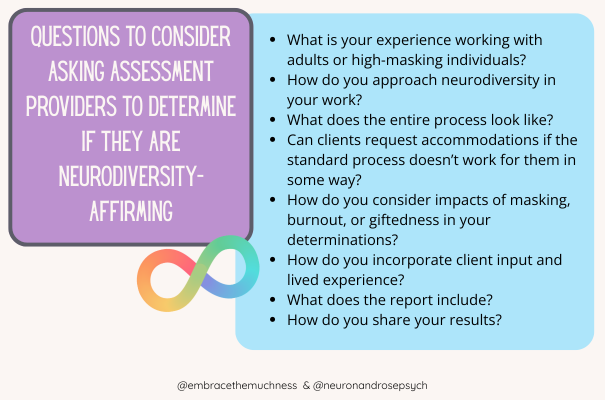
Before you even book with someone, you are absolutely allowed to ask questions. This isn’t you being difficult or “too much.” This is you practicing informed consent. You can ask about their experience with adults or high-masking individuals. You can ask how they approach neurodiversity in their work. You can ask what the process looks like from start to finish, how they consider masking and burnout, and how they incorporate client input and lived experience. You can also ask what the report includes, how feedback is delivered, and whether their recommendations are actually practical. A provider who is aligned with your needs will not be thrown off by these questions. If anything, they’ll welcome them.
Where to Start Looking
Finding these providers can feel a bit like a scavenger hunt, but there are places to start. Neurodivergent-led directories and communities can be helpful, like www.ndtherapists.com. Word of mouth is often one of the best resources.
Social media can also give you a sense of how a provider thinks and talks about their work. At the same time, it’s worth noting that “neurodiversity-affirming” is becoming a popular phrase, and not everyone using it is practicing it in a meaningful way. Look for substance. Do they talk about masking in a nuanced way? Do they acknowledge late diagnosis? Do they center lived experience? Do they use the MIGDAS-2 instead of the ADOS-2? Do they use identity-first language instead of person first language? Are they Autistic or ADHD themselves? If it’s all buzzwords and no depth, it’s okay to proceed with caution.
If you’ve had a bad assessment experience before, it makes sense if you’re hesitant to try again. A bad assessment can stick with you. It can make you question yourself, doubt your experiences, and wonder if you were somehow wrong for even considering this path. It can leave you more confused than when you started. None of that means your instincts were wrong. It means the process—or the provider—wasn’t a good fit. One provider’s perspective is not the final word on your identity. You are allowed to seek a second opinion. You are allowed to revisit the process later. You are allowed to find someone who actually understands your presentation.
Here’s the bottom line: you deserve better than “close enough.” You deserve an assessment experience that is collaborative, respectful, thoughtful, and actually useful. Not rushed. Not dismissive. Not rooted in outdated ideas about what neurodivergence is supposed to look like. The right provider will not make you perform your traits to be believed. They will help you understand yourself more clearly and walk away with something you can actually use in your real life.
So if you’re in that early “starting to look” phase:
Take your time.
Ask the questions.
Pay attention to how things feel.
You’re not just looking for an answer. You’re looking for someone who actually gets it—and that is worth being intentional about.
If this felt familiar in a way you can't quite explain — you don't have to figure it out alone. Neuron & Rose offers neurodiversity-affirming evaluations focused on understanding how your brain actually works, not making you fit a mold. Check us out here at: Neuron & Rose Psychological Services
If you're a clinician, The Divergent Clinician has trainings, resources, and community for learning how to do neurodiversity affirming autism and ADHD assessments without having to unlearn everything on your own: The Divergent Clinician | Neurodivergent Affirming Practices
And if you're not ready for either of those yet, that's okay. Sometimes the first step isn't doing something — it's just understanding yourself differently.

Written by guest blogger, Dr. Jessica Hogan.
Dr. Jessica Hogan is a licensed clinical psychologist and founder of Neuron & Rose Psychological Services and The Divergent Clinician. She specializes in neurodiversity-affirming autism and ADHD assessment across the lifespan, with a focus on late-diagnosed and high-masking individuals. As an AuDHD psychologist, her work integrates lived experience, clinical expertise, and research on autistic therapists to help both clients and clinicians move from self-doubt to self-understanding.
*For more info on finding Neurodiversity-Affirming Providers, check out a previous blog - Guide to Finding a Neurodiversity-Affirming Provider